Turbo Energy announced on 10 November 2026 additional orders valued at €6.83 million, or approximately US$7.62 million, within Pamesa Net Zero, an industrial energy programme at the Spanish facilities of Pamesa Group, which the company describes as Europe's largest ceramic tile manufacturer. The orders add a net 51 MWh of contracted battery storage capacity, covering installations at two new industrial sites and capacity increases at existing locations, according to the company release.
The orders cover battery energy storage systems, inverters, Turbo Energy's proprietary AI-driven energy management software and associated integration services, with equipment deliveries expected in the first half of 2027. The company says the new inverters add backup capability, allowing appropriately configured installations to supply designated loads during grid outages, subject to available solar generation, battery charge and connected demand. It says the order value is contracted business attributable to Turbo Energy and should not be read as revenue recognised in a single reporting period. The dollar figure uses an exchange rate of US$1.1154 per euro, the Federal Reserve H.10 rate for 6 November 2026. Shanghai Metals Market notes that site allocation, MW rating and commissioning dates were not disclosed.
The expansion builds on a contract of approximately $53 million announced in September 2025 for 366 MWh of storage across 10 factories. The company says the initial deployment has brought 62.5 MWh into operation across three industrial sites, and that its software began operating within the programme in July 2026. Chief executive Mariano Soria said: "Bringing the first installations into operation established an important foundation for the next phase of Pamesa Net Zero." The company also says a separate $3.5 million portfolio of 15 storage projects across Spain and Chile, announced in September 2026, excludes Pamesa.
The climate case
Pamesa Net Zero pairs new solar panels with batteries so Pamesa's factories can run on their own solar power for more of the day and night and buy less from the grid. The full programme covers 80.56 MWp of new solar and 366.84 MWh of storage, according to Estrategias de Inversión, with Turbo Energy's software deciding when to store and release power. Pamesa has also installed its first fully electric kiln, at its Ecoporcelánico plant, according to Ceramic World Web.
Ceramic tile making relies on gas-fired heat, and spray drying alone accounts for 60% of the sector's thermal energy, according to Pamesa's TAU Cerámica brand. Batteries that store solar electricity leave that gas use untouched on their own, so this order cuts emissions from the factories' electricity rather than from their dryers and kilns. The deeper cut depends on Pamesa moving that heat onto electricity, as it has started to do with the electric kiln.
How it fits the data
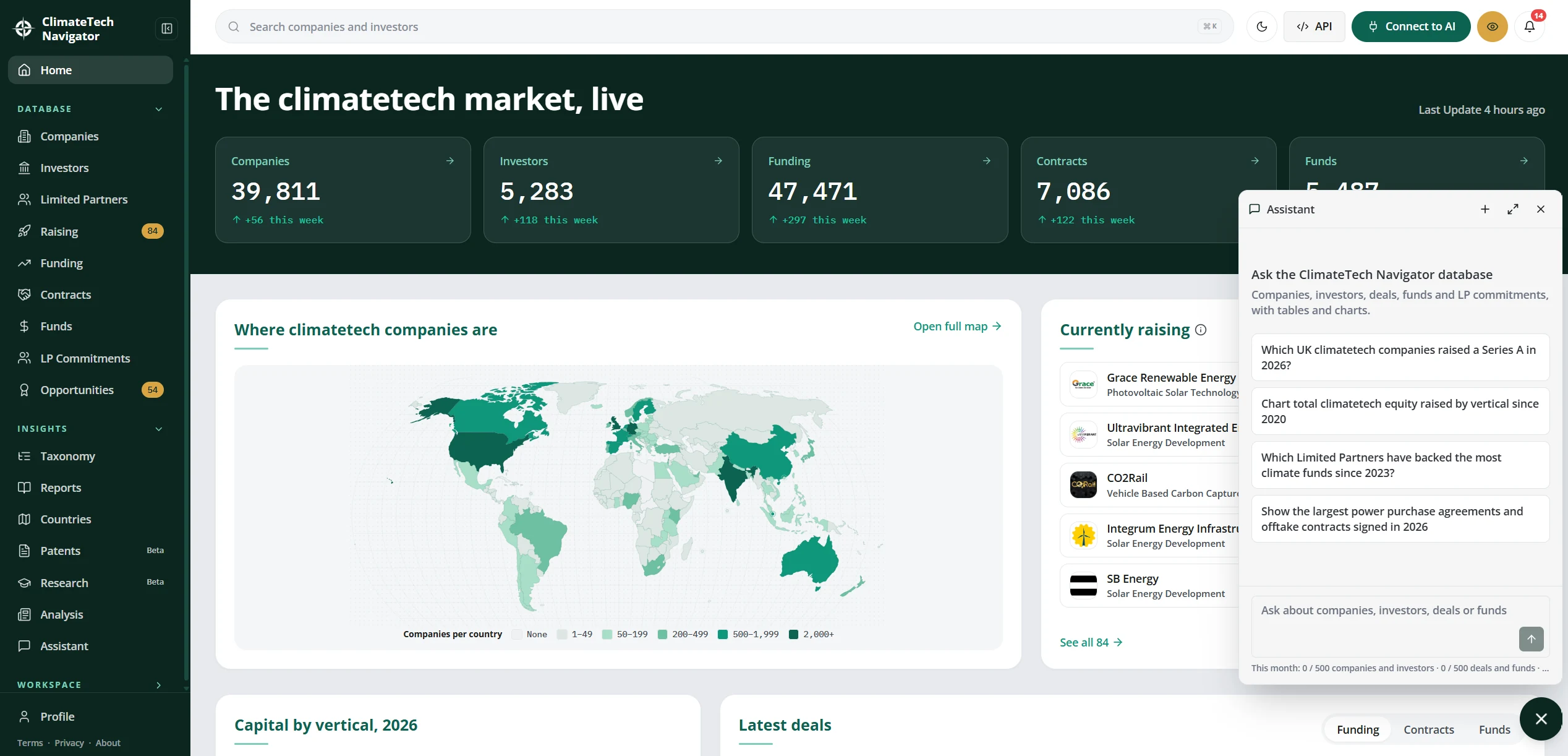
ClimateTech Navigator lists two Turbo Energy agreements with Pamesa, both under the Commercial Supply Agreement category: the September 2025 contract at $53 million and this November 2026 increment at $7.62 million. In the industrial production vertical, it has tracked 38 commercial supply agreements so far in 2026, with $477 million in disclosed amounts, against 50 agreements and $892 million in the whole of 2025.
Sources: Estrategias de Inversión, Ceramic World Web, TAU Cerámica, Turbo Energy release via Finviz, Shanghai Metals Market. Company profile
 The ClimateTech Navigator platform